This is the first installment of a new series where I examine ideas surrounding climate change. There is a lot of misinformation spread around and I think it’d be useful to have a forum where we can examine these ideas. I will be titling this series “Climate Change”. If you have any suggestions on what other series you’d like to see or if you have a suggestion for the next iteration of this series then please don’t hesitate to leave me comment!
Introduction:
In the UK, a new News channel has began to air called “GB News”, on one such airing a guest by the name of Matthew Ridley was being interviewed concerning the net zero target that the UK has committed to reach by 2050. During this interview, Mr Ridley makes certain assertions concerning an increase in surface vegetation cover on the Earth. Specifically he claims;
“NASA satellites have shown a greening of about 14% over 30 years, that’s equivalent to adding a continent’s worth of green vegetation the size of North America. And that’s in all habitats; rainforests, semi-deserts, arctic tundra. They’re all getting slightly greener because of this extra carbon dioxide, particularly arid environments.”
Through the following writing I’m going to examine these assertions one-by-one to see if they stand up to scrutiny and provide some comment surrounding increasing global vegetation, a concept I refer to as global greening, and how people use this concept when discussing climate change.
What is Global Greening?
The comments by Mr Ridley above are all part of a concept I refer to as “Global Greening”. This is the idea that human activities, notably the widespread combustion of fossil fuels, increase the concentration of carbon dioxide present in the atmosphere and this increase leads to a higher amount of biomass present on the Earth (hence the greening), and this leads to a higher amount of photosynthesis taking place.
Has Global Greening actually taken place?
Ridley asserted that:
“NASA satellites have shown a greening of about 14% over 30 years, that’s equivalent to adding a continent’s worth of green vegetation the size of North America [caused by an increase in carbon dioxide concentrations in the atmosphere].”
In order to verify this claim I feel it’s important to note how exactly the amount of vegetation on Earth is measured. NASA has been using satellite imagery to gauge the level of vegetation since the 1980s. They do this by measuring the visible light and near-infrared light reflected by the Earth’s surface back into space. Scientists then use an algorithm called a “vegetation Index” to quantify the density of green leaf vegetation and then they can combine this with 8- 16- or 30- day composites to create detailed maps of Earth’s vegetation cover (NASA).
As for the claim asserted above, there is strong evidence suggesting an overall increase in the abundance of green vegetation cover on the Earth’s surface. For instance, a Nature Climate Change study published in 2016 stated that “a quarter to half of Earth’s vegetated land has shown significant greening over the last 35 years largely due to rising levels of atmospheric carbon dioxide” (Zhu and Piao, 2016). The author’s also state the size of this increase is equivalent to an area twice the size of the continental United States. These results were backed up by a 2019 study which found that green vegetation coverage had increased by 5% since the early 2000s, making the 14% in the past 30 years a plausible statistic (Chen and Myneni, 2019).
Another aspect of the assertion above was that this increase was due in whole, or at least heavily, by increases in carbon dioxide present caused by human activities. There has been some research that has tried to disentangle the different inputs that have caused this increase in global vegetation cover. For example, the 2016 study above highlighted other potential causes such as nitrogen, changes in land use and climate change (through changes in temperature, precipitation and sunlight). They ran data for carbon dioxide and all other the potential variables separately through different computer models that mimic plant growth observed in the satellite data. They found that higher carbon dioxide concentrations were responsible for about 70% of the observed global greening; the next biggest factor was nitrogen at 9% of the observed changes (Chen and Myneni, 2019). This shows that carbon dioxide fertilisation is largely responsible for the increased green coverage observed.
However, whilst carbon dioxide may be largely responsible for increasing greening now, there is no guarantee that this will continue to be the case in the future. In biology, there is a concept that states that when a biological process relies upon two crucial components, the component in least supply will constrain the rate of the process. In the case of global greening, photosynthesis is the process being examined. Photosynthesis is a complex reaction that relies on multiple different inputs, carbon dioxide being only one of many. It is reasonable to assume, and the evidence discussed so far seems to suggest, that increasing carbon dioxide increases the amount of biomass on the Earth. However, this increase produced by carbon dioxide is only brought about if the carbon dioxide concentration is the limiting factor. It seems reasonable to envisage a scenario where carbon dioxide ceases to be the limiting factor, and therefore, any additional input into the atmosphere will cease to bring any further greening. There is some experimental data confirming this; for instance, there are trials of outdoor plots and the carbon dioxide increase was sufficient to produce an observable increase in biological productivity, 23%. However, one of the trials did not show a large increase due to a deficit of nitrogen, which constrained growth. There also appears to be a diminishing return to carbon dioxide saturation as increasing concentration yield less and less additional growth. Additionally, it is important to not view carbon dioxide fertilisation in isolation. Increasing carbon dioxide concentration is linked to rising temperatures and these temperatures can have an adverse effect on biological productivity like reducing “soil moisture, heat damage to plants, interfering with reproductive processes and increasing competition with weeds.” (Scientific American).
The distribution of Global Greening:
Ridley also stated that:
“And that’s in all habitats; rainforests, semi-deserts, arctic tundra. They’re all getting slightly greener because of this extra carbon dioxide, particularly arid environments.”
As previously stated above this global greening phenomenon has occurred in between a quarter to half of all vegetated areas on Earth over the past 30 years, only 4% has seen a decrease. This shows a significant increase in vegetation. The question becomes whether this occurrence is in all ecosystems. Boston University carried out some research searching for trends seen in the variation in vegetation cover and found strong increases in Australia, central Africa, the Amazon Basin, Europe and southeast United States. This shows that global greening does indeed appear to be global. However, there were some negative trends also observed in the northwest United States and central South America (Canadell and Wang, 2016).
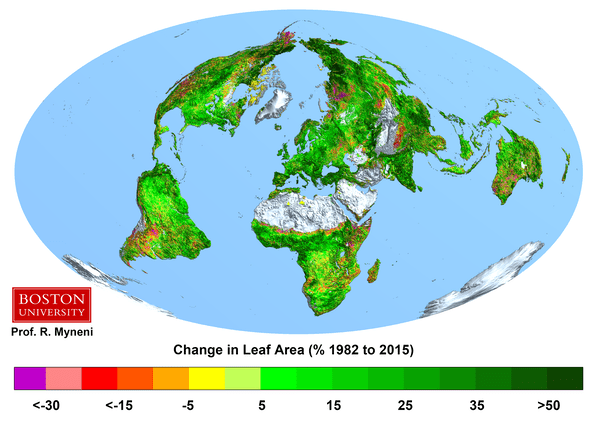
This appears to back up the above claim that global greening is impacting multiple different ecosystems. We know that most vegetated areas have experienced some greening and there has been very little decline in vegetated area (around 4%). All of this is to suggest that the global greening phenomenon is impacting all ecosystems.
Is this even relevant in the climate debate?
There are things that need to be expressed.
Firstly, Carbon dioxide concentrations are increasing significantly. Carbon dioxide levels in the world have reached 410ppm; levels like this haven’t been seen in at least the past 800,000 years and there is no sign that this increase is going to stop (Lindsey, 2020). This so-called global greening has done little to curb rising carbon dioxide concentrations.
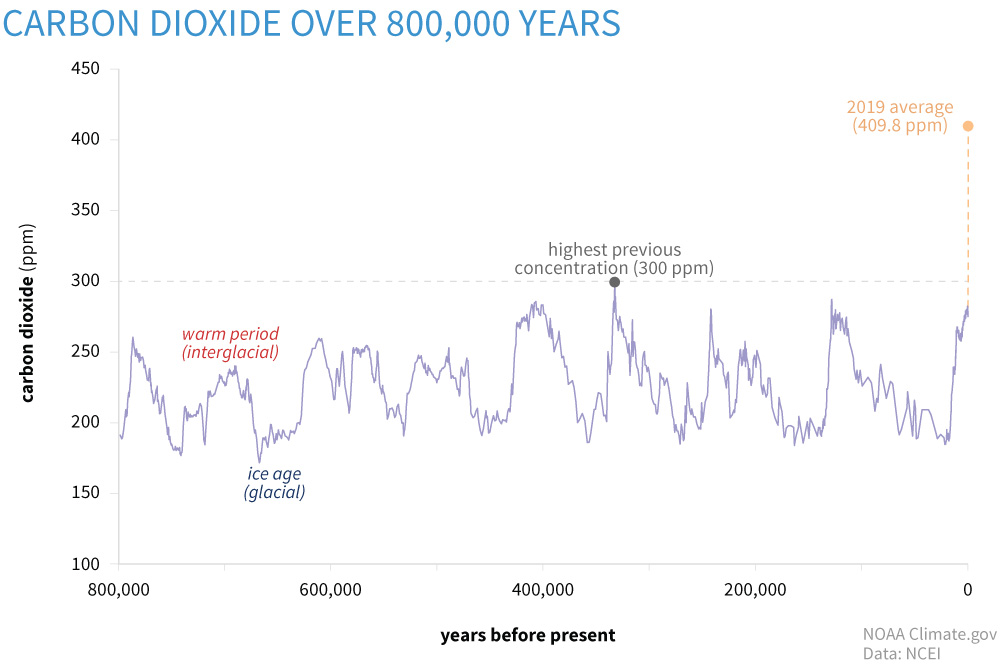
Secondly, global temperatures continue to rise. There has been an approximately 1 degree Celsius increase in average global temperature since the industrial revolution.
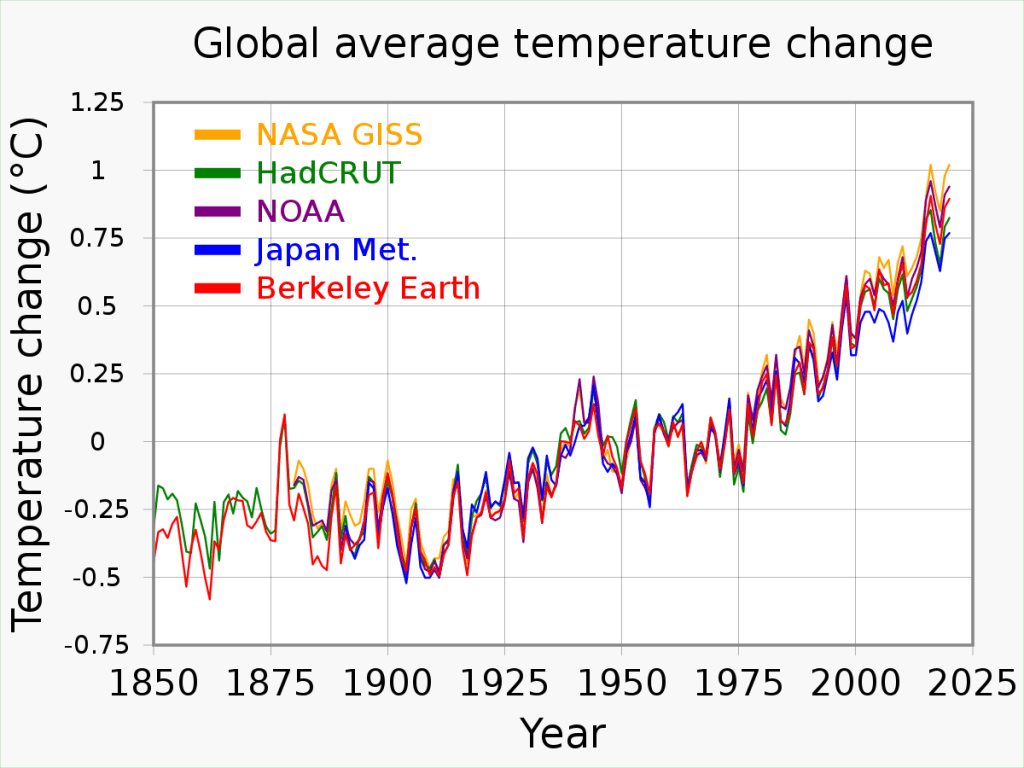
Here’s lays my confusion about the relevance of this phenomenon. If global greening is not enough to lower carbon dioxide concentration, or even curtail its growth, and global temperatures are still increasing then what relevance does global greening have in the climate debate? There is some evidence to suggest that this increase in vegetation is having a minor cooling effect. There are several methods through which can occur including increased evapo-transpiration, increased albedo, increased emissivity and by lowering aerodynamic resistance. However, despite this, the temperature lowering effect of these pathways only leads to an approximately 0.2-0.25 degree Celsius decrease in surface temperature (NASA Earth Laboratory). This is compared to the 1 degree Celsius increase that wouldn’t have occurred had humans not released the carbon dioxide into the atmosphere in the first place. Therefore, it seems that even if you invoke the cooling aspect of global greening it seems irrelevant as you’re just reversing a minority of the heating that the excess carbon dioxide has caused in the first place.
Conclusion:
It appears that the remarks made by Ridley on GB News were by and large accurate. There has been an overall increase in the area of green cover on Earth in the last 30 years, mostly produced by increasing carbon dioxide concentrations in the atmosphere driven by human activities and this effect appears to be occurring all over the Earth. The content of Ridley’s statement is not what I take issue with; it’s the relevance of it. It seems to me possible that someone may tune into this news segment, hear Ridley’s statement, and conclude that climate change is somehow being reversed through this global greening or that in order to solve the issue of climate change human action isn’t needed; two assertions I don’t believe are correct.
You may argue that the reason that Ridley didn’t include my above caveats is due to the short, fast-paced nature of the news channel. I don’t necessarily doubt that but I would respond by saying if you can’t convey a reasonably nuanced picture of a concept to your audience then you should be hesitant about bringing up said concept lest you misled your audience with an incomplete picture of events.
 The Wrong Opinion
An interesting post on climate change. Thank you 😊
LikeLike
Thanks for the kind words. I’m always open to feedback and constructive criticism!
LikeLiked by 1 person
You are welcome!
LikeLike