Introduction:
On the 15th August 2021, Kabul, the capital of Afghanistan, fell into the grip of the Taliban. The Fall of Kabul was accompanied with images and videos depicting a mass panicked exodus of Afghans from the city via Kabul Airport and reports of the abandonment of the various embassies that hosted the retreating countries. Shocking footage soon emerged of Afghan citizens falling out of the sky as they had hung from the side of departing aircraft, desperately attempting to flee. This exodus prompted the US and the UK to send troops back into the city to help extradite their citizens from the city as the Taliban closed in.
The purpose of this article will be to examine the recent history of Afghanistan and of the Taliban, appraise the role out of the current retreat and evaluate the benefits and failures of the NATO response and hopefully provide my comments on the topic.
The History of Afghanistan and the Taliban:
The recent history of Afghanistan begins with the Soviet-Afghan War, a conflict that stretched from 1979 to 1989 and involved a Soviet invasion and occupation of the country to support the newly formed Communist regime. The Soviets soon found themselves fighting a guerrilla war against the Mujahideen, a group of various different rebel groups. This style of fighting was incredibly effective against the Soviet invaders who, despite having far superior weaponry, were unable to cement their hold over the region. This led to a brutal strategy of “Mass Exodus” by the Soviets where villages were bombed, industrial centres were destroyed and “toy bombs” were used to target children and were specially designed to maim- not kill- as the idea was that injured families were far less likely to put up a fight. Within the first of year of this doctrines implementation, a million Afghans were killed. Due to this intense fighting, 6 million refugees fled to neighbouring countries, including Iran and Pakistan, many of whom were children. By 1988, the Soviet occupation was in retreat and they soon abandoned their Afghan communist allies, who tried but failed to reach a peaceful end to the conflict. The communist government held out until 1992, using left behind Soviet equipment but the Afghan Mujahideen soon captured Kabul. However, this victory was short-lived as different rebel groups began occupying different areas of the city and fighting broke out between them, this soon spread throughout the country.
Many of the children who had fled the country due to the brutal Soviet occupation had ended up in refugee camps. Many of these children escaped these refugee camps by enrolling in Pakistani Madaras’, religious educational institutions, 2,000 of such institutes existed along the Pakistan-Afghanistan border and over 200,000 children would be enrolled in such schools. Many of the students that were enrolled came to form the “Taliban”, which translates into “Students” or “Seekers”.
By 1994, The Taliban had managed to secure the Pakistan-Afghanistan border by dismantling Mujahideen checkpoints with the support of Pakistan and The Inter-Service Intelligence, a Pakistani intelligence apparatus. The Taliban soon spread, securing further territory and capturing military equipment from the Mujahideen they defeated. The Taliban soon reached Kabul in 1996 and controlled approximately 75% of the country. The Taliban partnered with Al-Qaeda in 1998, which had declared war on the United States.
Taliban War Crimes:
The Taliban are perhaps one of the most famous terrorist organisations to exist today but I feel the group’s crimes are not as well known as they should be hence why I have decided to dedicate a whole section to their atrocities:
Massacre Campaigns
A United Nations report detailed 15 massacres that occurred from 1996-2001. The documents also revealed that Arab and Pakistani troops supported such killings. Additionally, the UN also cites eyewitness testimony of people who witnessed such attacks who stated that they had seen Arab fighters entering villages with long knives that were used to slit throats and skin people. In 2011, the Taliban’s former ambassador to Pakistan described such acts of brutality as necessary.
Furthermore, in 1998, the Taliban were accused by the United Nations of denying 160,000 civilians access to emergency food supplies. The UN claimed the Taliban were using emergency assistance as a “weapon of war”.
Another notable example of a Taliban massacre is that of Mazar-i-Sharif, the fourth largest city in Afghanistan and home to half a million people. In 1998, the Taliban had seized the city and on 8th August they began the indiscriminate killing of the city’s inhabitants. Within 2 days, the Taliban had killed 8,000 non-combatants and had forbidden the burial of those they had killed for 6 days (going against Islamic injunction which requires immediate burial), leading to the dead being left in the street to rot and many being eaten by dogs. Along with this, the Taliban also hunted the Hazara, a Persian speaking ethnic minority that inhabited the area. Hundreds were executed; with thousands more being transported elsewhere in metal containers, leading to many dying en route due to asphyxiation.
The Taliban were responsible for a vast majority of the civilian deaths that occurred in the conflict in Afghanistan. They were reportedly responsible for 76% of civilian deaths in 2009, 75% in 2010 and 80% in 2011.
Human Trafficking
Several Al-Qaeda and Taliban commanders were believed to be running a sex slave network whereby they would abduct and sell minority ethnic women into sex slavery and forced marriages in Afghanistan and Pakistan. The conditions of such slavery were so extreme that many of these abducted women would commit suicide rather than live a life in slavery. One such instance of this barbaric practice being carried out was a Taliban offensive into the Shomali Plains in 1999, during which 600 women were kidnapped. Some of these women were transported beyond the Pakistani border, with the complicity of Pakistani border guards. Relief agencies say that many of these women ended up being sold to brothels and to private households to be owned as slaves.
Oppression of Women
The Taliban are notorious for their harsh treatment of women. Images of women forced into wearing the Burqa with households having to darken their windows lest the women inside be seen but the harsh treatment of people living under their tyranny, especially of women, is far more nefarious than even this would suggest. The Taliban issue edicts that forbade the education of women, with many being forced to leave school and college, a 1998 UNICEF report showed that 90% of girls and 66% of boys were not enrolled at school. Women were required to have a male chaperone; those that refused were punished harshly, one woman, Sohaila, who was caught being chaperoned by a man who was not a relative was publically flogged and received 100 lashes.
There were extensive bans on female employment. Female employment was restricted to the medical industry, where male medical personnel were prohibited from treating women and girls. The restriction of female employment within the education sector caused widespread closures of primary schools, as women made up a majority of teachers, leading to lack of educational access for many girls and boys.
The History of NATO Intervention:
To understand the retreat it’s important to understand the initial advance. The story of the NATO advance into Afghanistan begins in 2001, shortly after the tragic attack that occurred on 11th September 2001. Following the attacks, then President George W Bush ordered that the Taliban, the de-facto leaders to hand over Osama Bin Laden, founder of the Islamic terrorist group Al-Qaeda, over to US authorities, they declined to do so. This led to Operation Enduring Freedom, beginning with airstrikes on October 7th 2001 and ending in 28th December 2014 under the Obama presidency. The Taliban and their Al-Qaeda allies were soon defeated by US-led coalition forces and the Northern Alliance, a rebel group that had been combating the Taliban since their reign began in 1996. The new Afghanistan Interim Government was headed up by Hamid Karzai. The UN formed the International Security Assistance Force (ISAF) to help secure Kabul and a rebuilding effort was undertaken.
However, the Taliban soon returned after re-organising and launched an insurgency movement against coalition forces in 2003. This insurgency utilised tactics such as suicide bombings, guerrilla warfare and ambushes and the Taliban soon began to exert influence over the rural areas of Eastern and Southern Afghanistan. The Taliban continued to show a willingness to commit atrocities against civilians and violence escalated from 2007 with an increase in troop numbers introduced and a “clear and hold” doctrine for villages was undertaken. At the peak, in 2011, 140,000 coalition forces were occupying Afghanistan. In 2014, combat operations were ended and withdrawal of troops was carried out with the coalition leaving a residual force in the country tasked with support and training the Afghan National Army and National Police (ANA and ANP, respectively). This marked the end of Operation Enduring freedom, which was replaced with NATO-led Operation Resolute Support.
On February 29th 2020, under the Trump presidency, the US and the Taliban struck a conditional peace deal which required that the United States withdraw from the country within 14 months of the agreement. Joe Biden, who assumed office on January 20th 2021, pushed back the withdrawal to September 11th 2021, which would mark the 20th anniversary of the 9/11 attacks which was the impetus for the invasion, but then brought it forward to 31st August 2021. Although the Taliban re-surged as coalition forces withdrew with ANA and ANP offering little resistance and on the 15th August 2021, the Afghan President Ashraf Ghani fled and the Taliban declared victory.
The Retreat and the Current State of Afghanistan:
The US had invested considerable resources into financing and equipping both the Afghan National Army and the National Police, approximately $83 billion over the 20 year occupation. This begs the question as to why the Afghan National Army crumbled so quickly despite its immense size and resources relative to the Taliban, 300,000 ANA soldiers compared to 80,000 Taliban fighters. The issues that plagued the ANA were multi-pronged:
Corruption
Corruption is rife within, not only the AMA, but the whole Afghanistan political system. Commanders within the ANA routinely pocketed money that was destined for the wallets of their soldiers leading to many not being paid for months. Additionally, commanders were also known to have sold weaponry, ammunition and food on the black market with much of this equipment ending up in the hands of the enemy they were meant to be combating. Along with this, commanders inflated the size of their armed forces by submitting salary requests for “ghost soldiers” who had not actually enlisted, meanwhile their troops were serving without payment and lacking vital equipment and supplies.
Lack of Morale
Due to the aforementioned corruption, the ANA took heavy casualties and had high desertion rates. The attrition rate of the Afghanistan National Defence and Security Forces (ANDSF) was 5,000 a month, compared to recruitment rates of 200-300 and over the 20 year conflict the Afghan security forces had taken almost 70,000 causalities. The embezzlement of funds by commanders also took a heavy toll as the soldiers, who would go months without payment or resupply, witnessed the lavish lifestyles of their superior officers, causing troops to surrender rather than risking death by fighting.
Over-reliance on the US and NATO Forces
With specialised equipment comes the need for specialised knowledge, knowledge which the Afghan security forces did not possess. The ANA never developed the capability to stand on its own and had relied heavily on coalition forces for everything ranging from logistics, air power and maintenance. The loss of private US contractors, as needed by the peace deal with the Taliban, also led to the loss of the ANA’s key advantage- air power, along with their armoured vehicles and other specialised equipment. Without these key contractors, the Afghan Air Force was practically grounded and its armoured vehicle capability severely hindered. The ANA also relied upon NATO forces to protect urban areas, so when the withdrawal occurred there was little resistance to be mustered when the Taliban began to siege these urban areas.
Sudden Departure of US and NATO Forces
Irrespective of whether you think the withdrawal should have happened in the first place, it is hard to deny that it was not carried out incompetently. Bagram was the US’ biggest airfield in Afghanistan and was the epicentre for its involvement in the country and on the 2nd July 2021, the US had completely vacated the facility in advance of the total withdrawal- without notifying the Afghan commander who found out 2 hours after they had left.
In addition to this, many military advisors had warned President Joe Biden that the planned withdrawal date was far too soon. The Wall Street Journal reports that top military officials advised that President Biden should keep a small force of 2,500 soldiers stationed in Afghanistan whilst a peace deal is struck between different warring groups- President Joe Biden denies this.
Finally, the US not only did not inform the Afghan commander that they were leaving but they also ignored the advice of their closest allies. An MoD official claims that the UK contacted the White House stating that they thought the timetable for US withdrawal was “too aggressive” and that the British had been “caught by surprise” by the pace of retreat as they had been left in the dark over discussions that took place between US and Taliban. This is in conjunction with reports that are claiming that President Joe Biden also ignored phone calls from UK Prime Minister Boris Johnson for 36 hours as he tried to reach him as desperate Afghans began to swarm Kabul as the Taliban closed in. This quick departure, so quick that even many of the US’ closest allies were caught off guard and ignored could go a long way to explain the lack of resistance that the Afghan security forces could produce as they were not prepared to fight without NATO assistance.
The Costs of the War in Afghanistan:
The cost of the NATO involvement in financial terms were staggering, particularly the US cost of involvement which has been estimated to be around $2.261 trillion and the UK involvement has been estimated at around £22 billion from 2001 to 2014 (Operation Herrick- when most combat operations were taking place and the bulk of the cost, both financially and in human life, were the highest) although overall costs of the war for the UK are placed at around £27.7 billion. In terms of manpower the UK lost 457 personnel contrasted with the US’ 2,401 personnel. As a side note, I wish to draw particular attention to the costs inflicted upon the brave men who served in the ANA and ANP; they took the bulk of the causalities, suffering 78,414 deaths overall compared to the 3,586 losses that NATO forces endured. Their sacrifices are important and must not be forgotten. The overall cost of the conflict and the apparent lack of real change are the main drivers behind calls to retreat and pull out from Afghanistan. However, in the next paragraph I hope to show some of the beneficial progress that was made as a result of NATO involvement.
The Benefits of the NATO Presence:
There were numerous examples of progress that were a result of NATO intervention. Aljazeera has a brilliant article on this that I recommend everybody reads. They state multiple instances of progress being made in Afghanistan as a result of the past 20 years of involvement. An example of these beneficial improvements include an increase in life expectancy from 56 years to 64 years (although this is still below the global average of 73 years), a drop in infant mortality of 15,000 in 2001 to 7,700, the unemployment rate fell from 11.58% to 8.84% (although this is still above the global average of 5.49%), an increase in HDI (Human development index which measures overall standard of living) from 0.37 to 0.5, an increase in their human rights score from -2.51 to -2.31, GDP was experiencing double-digit percentage increases up until the mid-2010s and a series of other health measures have improved as seen in figure 1. Some improvements were made and the lives of the people living in Afghanistan have improved since the intervention by NATO.
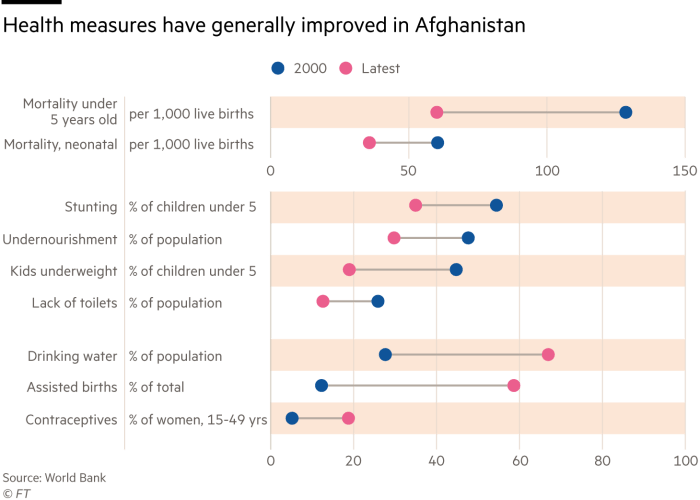
Much of these improvements are threatened with the Taliban takeover. The Taliban have already begun to crackdown on protests, detaining and beating journalists and reforming their “Ministry of Promotion of Virtue and Prevention of Vice” which cracks down on behaviour which is deemed as “un-Islamic”. This is all coupled with two announcements in early and then late September 2021 where the Taliban named an all-male interim government, despite promises of an inclusive cabinet and then appointed all-male deputy ministers, despite the resulting international outcry concerning the initial government appointments. This shows the Taliban government show little regard to international condemnation and show that they more closely resemble their previous leadership more than was hoped.
Conclusion and my Final Thoughts:
I do have some concluding thoughts that I would like to mention. Firstly, I have read much about the Taliban takeover as part of my research for this article and one argument that I have come across consistently is the “sunk-cost fallacy”- which describes the tendency of people to follow through on endeavours that they have already invested into regardless of the current benefit-cost analysis. The last part of that explanation is critical as I believe the people who advance this argument are misinterpreting the fallacy by being against the intervention simply because of the staggering costs associated with it and are not looking at the cost-benefits of a pull out. Most of the costs associated with the Afghanistan have already been spent during the combat operations, which ceased in 2014. The costs for the initial stages- 2001 and 2002- were around £300-£400 million (for the United Kingdom). This fell by about 85% for the next few succeeding years but the costs began to ramp up when Operation Herrick began and British troops were shipped to Helmand province. The post-combat stage of the conflict- Codenamed Operation Toral in the UK- had a cost of around £90 million annually. Additionally, the last British causality to die from combat related injury was Lance Corporal Michael Campbell in 2015 (he died from injuries sustained in 2012). The latest British causality to die in Afghanistan was Private Joseph Berry who died from non-combat related injuries sustained whilst on operations in Afghanistan. This shows that the cost to the UK taxpayer was fairly minimal and it helped ensure a stable Afghanistan.
However, one valid criticism is that due to the peace deal signed between the US and the Taliban, the Taliban had created a ring of protection around US forces by protecting US military bases and redirected their own attacks. This was in return for a full US withdrawal within 14 months and had they not withdrawn completely this ring of protection would have undoubtedly eroded, leading to an intensification of the conflict which will intensify NATO causalities and the associated cost of potentially renewed combat operations. The question should be “would the potential increase in causalities and financial commitment be worth safeguarding the progress made in Afghanistan?” This debate was never had; the United States pulled out, going so far as to not alert the Afghan National Army or its closest allies, including the United Kingdom and the ANA and people of Afghanistan were abandoned by the very people who promised to protect them.
An additional point I wish to stress is that this was not inevitable. NATO forces had ceased direct combat operations and had switched to a support and train role. The ANA and the ANP were capable of holding off the Taliban with the support from NATO that they were receiving. Figure 2 shows the proportion of Afghan districts that were either contested, under Taliban control or under Afghan government control and the Taliban takeover only began shortly after the US withdrawal began.
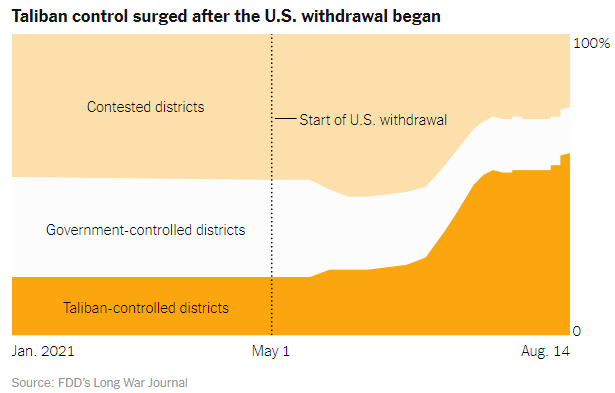
My final word on the matter is what to do now. NATO forces have withdrawn and the Taliban have taken over and are showing concerning signs that suggest their reign will be little different to their previous control but there are still things we can do. Many countries re-entered Kabul to secure the airport to allow the evacuation of people, primarily citizens of their respective countries and of afghan interpreters who risked their lives to support our work. The United Kingdom has two different but coinciding programmes aimed at allowing in Afghan refugees. The first is the Afghan Relocation and Assistance Policy (ARAP) which is aimed at resettling afghan nationals who supported British efforts in Afghanistan. An additional programme has since be set up known as Afghan Citizens Resettlement Scheme (ACRS) which aims to welcome 5,000 afghan refugees in the first year, with 20,000 refugees being welcomed over the long-term. These programmes are a good start but don’t go far enough. The ACRS should be expanded to allow more refugees being welcomed both in the short and long-term. We also need to have a international coalition that will work together to hold the new Taliban government to account as there are millions of Afghans who will never be able to leave their country and the Taliban must be pressured to respect the rights of their citizens, with a particular focus on the rights of women and girls to have access to secure homes, to gainful employment and to a high quality education. We have a moral obligation to help these people and must do whatever we can to help them to have as a secure and free a life as possible.
 The Wrong Opinion