Introduction:
In 2019, the government had announced plans that they would bring forward a law that would make confirming your identity mandatory before you could exercise your right to vote. Additionally, the government also added that any new legislation would make any such “voter card” free of charge and a wide range of documents would also be accepted. This new legislation is being brought forward to tackle voter fraud and to “protect and modernise our precious democracy”.
As you can probably tell by the title of this post, I’m highly skeptical of such a practise and I hope to spell out some of the reasons why I’m skeptical of the government proposals.
Voting is sacred:
I have some very interesting evidence that I will be bringing up later on in the article but before that I wish to lay some ground work. We live in a democracy, meaning a person’s vote is their voice. It is how they affect change around them and how they change the destiny of this country. The enfranchisement of women, minority people and the poor classes are rightfully celebrated in our culture as it marked the onward progression of our society. Therefore, we must be inherently dubious of any government proposal that may make it harder for certain people to vote. Also, if such systems are to be put in place to keep elections secure then it must be founded on solid evidence. I believe that the default position should be that we make voting as easy as possible and erect as fewer obstacles as possible between the voter and the ballot box. Any obstacles that are deemed necessary should based upon sound evidence and directly targeted at the problem at hand. I don’t believe the current proposals meet this standard as I will discuss later in this piece.
Also, as an aside, we should also be inherently suspicious when politicians strive to make voting harder, particularly when the obstacles they are proposing would disproportionately hinder the demographics that are also least likely to vote for them in elections (not saying the conservatives are doing this but caution is advised).
How many people have access to photograph ID
This is a mostly irrelevant section I’ll admit as the government are stating that they would supply people with a “voter card” free of charge and that a wide range of documents would be allowed to be used. However, I feel it’s important to know the following facts. The Electoral Commission (EC) found that 3.5 million people (7.5% of the electorate) have no photographic ID that was acceptable for a voter ID scheme and that 11 million people (24% of electorate) don’t have a valid passport or driving license. The EC also stated that certain groups were less likely to have valid ID. They noted older people and those in certain geographical locations (North Wales- 80% hold a valid passport compared to 94% in London). In terms of racial disparities the average across all ethnic groups of holding a valid passport was 85% although certain groups like Gypsy or Irish traveller and those of a mixed minority background had lower rates of passport ownership- 66% and just fewer than 85% respectively- (The Electoral Commission, 2015).
This shows how important it is to get this type of legislation correct. If it were the case that the government was not going to provide a “voter card” then we could see a significant minority of the electorate losing their right to vote, many of these people would disproportionately belong to a minority group.
Voter schemes and Voter Fraud:
As seen above, the costs of getting this kind of legislation wrong are immense. So, it would stand to reason that the benefits of this type of legislation are also quite significant. Luckily, there is some evidence we can look towards to ascertain just how widespread of a problem voter fraud is in the UK. In May 2019, there was a voter ID scheme that took place alongside local elections. Ten pilot areas were chosen in England to host the scheme. In some areas a specified form of photo ID was required, whilst other areas allowed 2 forms of unspecified ID (a utility bill and bank statement, for example). Overall, 1,968 people were turned away for not fulfilling the requirement and 740 did not return to vote (38% of the people turned away). In total, this represents 0.03% and 0.7% of the total votes cast. Furthermore, trials in 2018 showed similar results in five trial areas. Between 31% and 34% did not return to the polling booth after being turned away. This represents 0.06% to 0.4% of the total votes cast. This shows that voter ID laws can and do restrict the right to vote for some people.
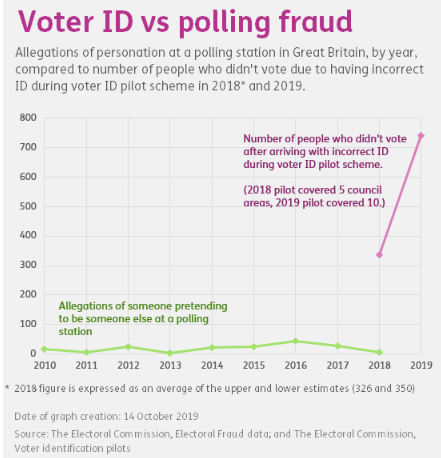
In elections that took place from 2010 to 2018 across the whole country, 181 people were accused of election fraud. Many of these accusations were not taken further. These 181 accusations is a quarter of the 740 people who did not return after being turned for not having a valid ID in the 2019 trials. Furthermore, there were only two convictions of election fraud between 2010 and 2017.
More recently, in the last election, there were only six cases of confirmed election fraud across the whole country. This is six cases out of over 47.5 million votes cast in total.
Figure 1 shows a table created by FullFact that shows the number of people accused of impersonating another voter compared to those that were turned away and did not return to vote in the 2018 and the 2019 pilot schemes.
Conclusion:
In conclusion, voter ID laws will do little to combat voter fraud, mostly because voter fraud is a tiny problem. This scheme seems to be a solution in search of a problem. It is likely that if these plans are brought forward and enshrined in law then many more people will be turned away for no real reason than the number of people who will be stopped from committing voter fraud. In addition to this, the demographics of the people who are more likely to be turned away is also very unsettling as ethnic minorities, older people and those in certain geographical locations are the least likely to have approved forms of ID which carries the risk of mass disenfranchisement if ministers get this legislation wrong. Voter ID laws carry too high a risk for too little of a reward for the government to continue on this dangerous path and they should be scrapped immediately!
 The Wrong Opinion